

Personal Trainer Cost: Spend Less on the Noise. Invest More in You.
Think you can’t afford a personal trainer? Before you decide, take an honest look at where your money is going. You might be surprised by what you can afford when you decide your health matters.
Let’s be honest for a minute.
You can DoorDash dinner instead of cooking. You can buy the $200 sneakers when a $100 pair will do the job. You can subscribe to six streaming services because there’s always something else to watch.
Those are your choices. And there’s nothing inherently wrong with enjoying the things you work hard to afford.
But if you’ve searched for personal trainer cost, looked at the prices, and immediately decided it’s too expensive, I have a question for you.
Have you actually looked at your spending?
I’m not talking about choosing between groceries and a personal trainer. I’m not suggesting you skip your rent or put your family’s needs at risk. I’m talking about discretionary spending, the money we spend on things we want, the little luxuries we’ve convinced ourselves we need, and the habits we’ve never stopped to question.
Because there’s a difference between not having the money and deciding that something isn’t worth spending money on.
And when we’re talking about your health for the next 30, 40, or even 50 years of your life, I think it’s worth having that conversation.
What Does a Personal Trainer Cost, Really?
The cost of a personal trainer depends on the type of coaching, how frequently you train, where you train, and the level of individual attention you receive. One on one training, small group sessions, and virtual coaching can all have different price points.
But here’s where I think people sometimes get stuck.
They look at the cost of personal training as an isolated expense. They see a monthly price and compare it with zero, rather than considering what that investment might provide or whether they could make room for it in their budget.
That’s understandable. We all have bills to pay.
But have you ever added up what you’re spending on the little things throughout the month?
How many times do you order delivery when you could make something at home? How many streaming subscriptions are you actually using? Do you need the most expensive version of everything you buy, or have you simply gotten used to buying it?
Individually, these expenses don’t always seem like much. Ten dollars here, twenty dollars there. It’s easy to justify each purchase because none of them feels like a big deal.
Add them up over a month, and the picture can look very different.
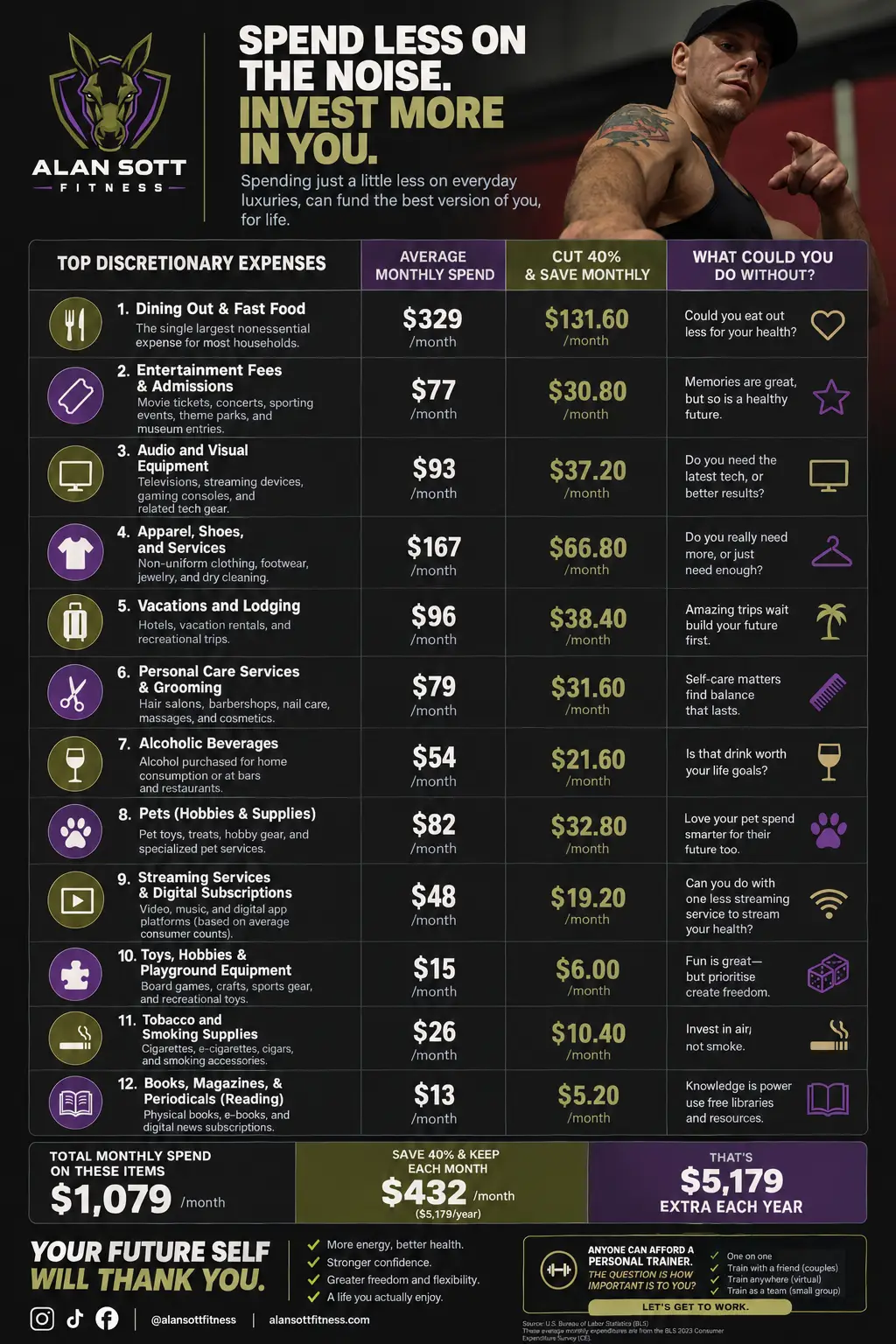
The graphic uses illustrative spending figures totaling $1,079 per month. Reducing that amount by 40% would free up approximately $432 per month, or $5,179 per year.
Those figures aren’t a prediction of what you’ll save. They’re not a personalized budget, and your actual spending may be very different. The categories and underlying figures should be considered in the context of the cited Bureau of Labor Statistics data.
The point is simpler than the math.
If you could redirect even a portion of your discretionary spending, what else might that money make possible?
Maybe it’s personal training. Maybe it’s a gym membership, better equipment, or another investment in your health you’ve been putting off.
Before you decide the personal trainer cost is out of reach, take a look at the numbers in your own life.
Is a Personal Trainer Worth the Cost?
Here’s where some people might disagree with me.
I believe that many people who say they can’t afford a personal trainer haven’t necessarily determined that they can’t afford one. They’ve decided that personal training costs more than they’re willing to spend.
Those are two different things.
And I understand that financial circumstances vary. Some people are struggling to cover basic necessities. Others have responsibilities and expenses that leave very little room for anything extra. I’m not dismissing those realities.
But for people who do have discretionary spending, it’s worth asking an uncomfortable question.
Have you decided that investing in your health is too expensive before examining what you’re spending on everything else?
You might decide that your daily coffee is worth every penny. Fine. Maybe you love going out to dinner, and that’s an important part of your social life. Keep doing it.
But do you need every DoorDash order? Do you need six streaming services? Do you need the $200 sneakers when a $100 pair meets your needs?
I’m not telling you what you should value. I’m asking you to decide what you value, consciously, rather than letting your spending habits make those decisions for you.
Because if your health matters to you, it deserves a place in that conversation.
And that’s the real question behind personal trainer cost. Not simply what a trainer charges, but whether the value of the service justifies making room for it in your budget.
You’re Investing in More Than a Workout
When I talk about investing in your health, I’m not talking about chasing a six pack or looking good for your next vacation.
I’m talking about the person you’ll be 30 years from now.
Will you have the strength to do the things you enjoy? Will you be able to carry your groceries, climb the stairs, travel, play with your kids or grandkids, and maintain your independence as you age?
None of us can guarantee what our health will look like decades from now. Genetics, illness, injuries, and circumstances beyond our control all play a role.
But we do know that physical activity has meaningful health benefits. Regular activity can improve sleep, support mental health, help manage chronic conditions, and maintain strength and physical function as we age. Muscle strengthening is an important part of that picture, too.
The Centers for Disease Control and Prevention explains these benefits in its overview of physical activity and health.
No personal trainer can promise to prevent every health problem. No honest coach should promise that.
What good coaching can provide is guidance, structure, accountability, and a plan built around your goals and abilities. It can help you learn proper exercise technique, make informed adjustments, and build a routine you can sustain.
That’s what you’re paying for, not just the minutes you spend lifting weights.
When you evaluate personal trainer cost, consider what you’re actually getting in return. You’re investing in professional guidance and a process designed to help you make progress, not purchasing a guaranteed outcome.
And you’re investing in something that matters long after the workout ends.
Skin in the Game Matters
Over the years, I’ve worked with people from different backgrounds and financial circumstances. Some of my clients have had to make very deliberate decisions to afford personal training.
I’ve noticed something about many of those clients. They appreciate the investment they’re making in themselves.
They made a conscious decision that their health was important enough to make room for it in their budget. They understand what they’re committing to, and they want to make that commitment count.
I think there’s something powerful about that.
When you make a deliberate investment in yourself, you have skin in the game. You’ve made a choice about what matters to you, and now you have an opportunity to follow through.
Of course, paying for a trainer doesn’t automatically make anyone disciplined. The work still has to happen. You still have to show up, put in the effort, and take responsibility for your choices.
That’s true whether you pay for one on one coaching, train with a friend, or work with a small group.
A trainer can guide you, hold you accountable, and help you adjust when things go sideways. But you are the one who has to do the work.
And when you’ve consciously decided that this investment matters, you have one more reason to take it seriously.
How to Make Personal Training More Affordable
If you’ve looked at personal trainer costs and decided that one on one coaching doesn’t fit your budget, that doesn’t necessarily mean you have to give up on professional guidance.
You have options.
Train with a friend. Sharing training sessions can help spread the cost while giving you access to professional coaching. You also have someone beside you who’s working toward their own goals.
Consider small group personal training. Training with a small group can make individualized coaching more accessible. You still get professional guidance, but the format differs from a dedicated one on one session.
Explore virtual personal training. If you want individualized programming and accountability, virtual coaching may be worth considering. Depending on the service, you can work with a trainer without needing to meet in person.
Choose the level of support you actually need. The most expensive option isn’t automatically the best option for you. Consider your goals, your experience, your budget, and the amount of coaching you need to stay consistent.
At Alan Sott Fitness, I offer one on one training, training with a friend, small group training, and virtual coaching. Each option provides a different way to approach your training.
The right choice depends on your circumstances. The important thing is to find an approach that fits your needs and gives you a realistic opportunity to succeed.
You don’t need the fanciest gym or the latest fitness gadget. And you don’t have to overhaul your entire life overnight.
Start by looking at your budget honestly. Identify what you can reduce without compromising your necessities or the things that genuinely matter to you. Then look at the coaching options available with the money you’ve freed up.
You might discover that something you assumed was impossible is more attainable than you thought.
Spend With Intention. Invest in Yourself.
I’m not asking you to stop enjoying your life.
I’m asking you to think about the life you’re trying to build.
Spend money on the things you love. Enjoy dinner with friends. Take the vacation. Buy something nice when it makes sense.
But don’t automatically treat those expenses as necessities while treating your health as a luxury.
Looking good isn’t the goal. Looking good is a byproduct of being healthy.
We’re not training so you can be your best inside these walls. We’re training so you can be your best outside these walls.
That means investing in more than how you look today. It means working toward the strength, capability, and physical independence that can help you enjoy the years ahead.
You don’t need to make every possible sacrifice. You don’t need to be perfect. You need to decide what matters, make choices that reflect those priorities, and stay consistent.
So before you tell yourself you can’t afford a personal trainer, take an honest look at the numbers.
You might not be able to afford everything you want. None of us can.
But you may have more choices than you think.
Spend less on the noise. Invest more in you.
Your future self will thank you.

About Alan Sott Fitness
Alan Sott Fitness is personal training built around real results, long-term health, and consistency over shortcuts. Founded by Alan Sott, a certified personal trainer who lost 100 pounds on his own fitness journey, ASF helps clients build strength, improve their health, and create lasting change through personalized training, practical nutrition guidance, and accountability. Serving Florida’s Treasure Coast in person and clients anywhere through virtual training, Alan’s philosophy is simple: Control the weight. Don’t let the weight control you.
Are you ready? Let’s get to work.
Sources
Centers for Disease Control and Prevention. Benefits of Physical Activity.
U.S. Bureau of Labor Statistics. Consumer Expenditures in 2023.
Disclaimer: This article is for general educational purposes and is not financial or medical advice. Individual budgets, health needs, and results vary.