

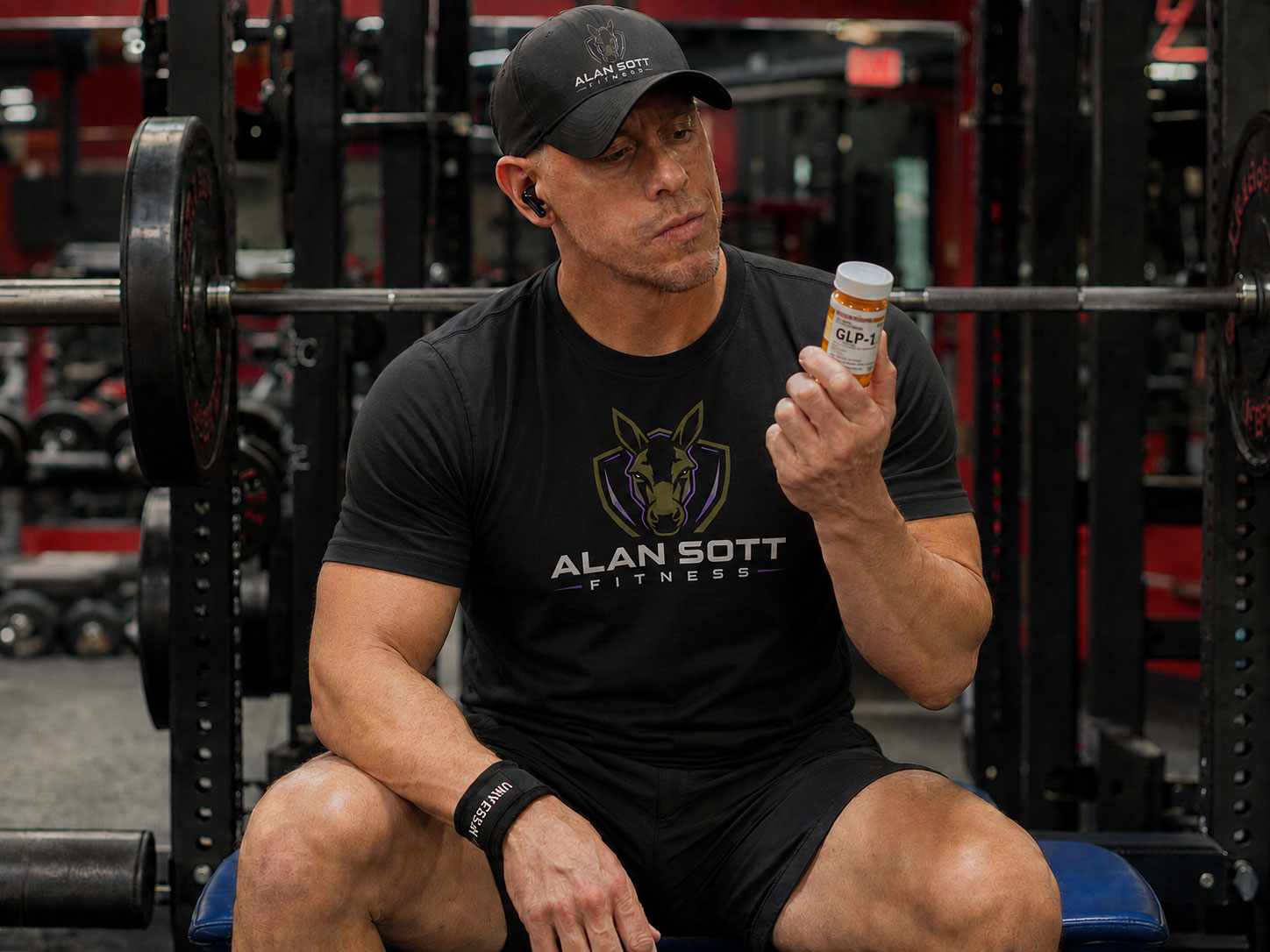
GLP-1 Medications Can Be a Tool. They Aren’t the Solution.
Let’s get something out of the way right now:
GLP-1 medications work.
I’m not going to pretend they don’t. The science is real, and for some people, these medications can be an incredibly useful tool for managing obesity and improving their health.
But here’s where I have a problem:
Losing weight isn’t the same thing as learning how to live healthy.
And if your only goal is to get skinny without changing how you live, you’ve missed the point.
So, What Exactly Is a GLP-1?
In very simple terms, GLP-1-based medications affect the systems in your body that regulate things like appetite, hunger, and blood sugar. They can help people feel fuller, eat less, and ultimately lose significant amounts of weight.
That’s real.
And for someone struggling with obesity, especially someone dealing with serious weight-related health problems, that can be a very big deal.
I’m not a doctor, and I’m not here to tell you whether you should take one. That’s a conversation you should have with your healthcare provider.
But I am a personal trainer, and there’s something I think gets lost in the conversation.
The medication can change what is happening inside your body. It doesn’t automatically teach you how to live differently.
That’s where the work begins.
A GLP-1 Pill Doesn’t Build Your Habits For You
Imagine you take a GLP-1 pill and suddenly you’re not thinking about food all day.
That’s fantastic.
But what happens next?
Do you:
- Learn how to eat in a way you can maintain?
- Learn how much protein you actually need?
- Start resistance training?
- Build cardiovascular fitness?
- Get stronger?
- Learn how to prepare meals?
- Learn how to manage your food when you’re stressed?
- Build a routine you can actually live with?
- Learn how to make better decisions when nobody is watching?
Or do you simply eat less, watch the number on the scale drop, and assume you’ve solved the problem?
Those are two very different outcomes.
The first one is building a healthier life.
The second one is losing weight.
Those aren’t necessarily the same thing.
And Then There’s Muscle
This is the part I really want people to understand.
When you lose weight, you don’t want to lose everything.
You want to lose excess fat while doing everything you reasonably can to maintain, and ideally build, your muscle.
Research on GLP-1 and related incretin medications shows that weight loss is predominantly fat loss, but some lean mass is lost as well. Recent analyses have found that lean mass can represent a meaningful portion of total weight lost.
That’s important because muscle isn’t just something you build so you look good in a tank top.
Muscle helps you move.
It helps you stay strong.
It helps you maintain physical function as you get older.
And from a training perspective, maintaining muscle gives you a much better foundation for the person you’re trying to become.
That’s why resistance training matters during weight loss, whether you’re using a GLP-1 or not. Recent research suggests that combining weight-loss treatment with resistance training and adequate protein can improve preservation of lean mass.
The goal shouldn’t simply be a smaller version of you.
It should be a stronger version of you.
Here’s Where I Think GLP-1 Medications Can Be Amazing
Let’s say you’ve spent years struggling with your weight.
You’ve tried diets.
You’ve tried doing it yourself.
You’ve started and stopped.
Maybe your weight is now creating immediate health problems.
And you’ve reached a point where you need help getting the process moving.
That’s exactly where I think a GLP-1 can be a tool.
Use it.
But don’t stop there.
If the medication makes it easier for you to control your appetite and begin losing weight, use that opportunity to completely change the way you live.
Retrain your brain.
Build new habits.
Get stronger.
Learn how to eat.
Learn how to move.
Learn how to take care of yourself.
Then you’re not just relying on the medication to produce a result.
You’re becoming the person who can maintain that result.
And Maybe You Don’t Need the Tool
This is the other side of the conversation.
Some people aren’t dealing with a medical emergency. They’re healthy enough to exercise. They’re capable of changing their nutrition. They simply haven’t figured out how to do it consistently.
Maybe they don’t have the knowledge.
Maybe they don’t have the accountability.
Maybe they’ve tried doing it alone and failed.
That doesn’t necessarily mean they need a medication.
Maybe they need help.
That’s one of the reasons personal training exists.
You don’t have to figure everything out by yourself.
A good trainer can help you learn what to do, teach you how to do it, hold you accountable, and, most importantly, help you build habits that don’t disappear when the training session ends.
Because that’s the whole point.
As a personal trainer, I don’t want you dependent on me forever.
I want you to learn something you can take with you.
I Learned This From One of My Clients
I once trained a woman who had already lost a significant amount of weight using GLP-1 pills.
And she was still unhappy with how she looked.
That’s an important lesson.
The number on the scale had changed.
But she hadn’t necessarily gotten the result she imagined.
She was dealing with more loose skin than she expected after losing the weight quickly, and she was still unhappy with her body.
I’m not telling that story to blame the medication. Rapid, significant weight loss can produce changes in appearance that people don’t necessarily anticipate, and everyone’s experience is different.
I’m telling it because, even though she may have not known it at the time, weight loss was never her entire goal.
If your goal is simply to weigh less, a scale can tell you when you’ve succeeded.
If your goal is to become healthier, stronger, more capable, and more confident in your own body, the scale isn’t enough.
So Here’s My Take
GLP-1 medications can be a tool.
They can help someone who genuinely needs medical assistance begin changing their health.
But they aren’t a magic pill.
They don’t build your habits.
They don’t teach you how to train.
They don’t make you stronger.
They don’t teach you how to make better decisions when life gets difficult.
And they don’t automatically create a lifestyle you can maintain.
That’s your job.
So if you’re taking a GLP-1 medication, don’t waste the opportunity.
Use the time when the medication is helping you to build the person you want to be without it.
And if you’re considering a GLP-1 because you simply don’t know how to do this on your own, ask yourself one more question:
Do I actually need the medication, or do I need someone to teach me how to do this?
Because sometimes the tool you need isn’t a prescription.
Sometimes it’s a plan, some accountability, and someone standing beside you while you learn how to do it yourself.
A quick disclaimer, because apparently the internet requires one:
I’m a personal trainer, not a physician. This article is about fitness, behavior, and my perspective as a coach—not medical advice. If you’re considering starting, stopping, or changing any medication, talk to your healthcare provider first.
STILL LOOKING FOR THE MAGIC PILL?
I can’t promise I have one.
What I can do is help you build something that doesn’t stop working when the bottle is empty.